
Among the words that have accompanied us throughout the first half of 2026, the term ‘sovereignty’ certainly holds a prominent place. Derived from the Latin ‘superanus’, meaning ‘above’ or ‘head’, sovereignty – which takes on as many different meanings as there are fields of application – is at the forefront of corporate, institutional, political and social agenda-setting.
With data being the gold of the new century, a mention must be made of digital sovereignty: and here, first and foremost, we need to establish the rules of the game because, used as it is, this risks becoming an empty slogan. The key point, in this writer’s view, lies in the definition: the sovereign is not the one who hosts the data, but the one who truly controls it.
Let’s take things in order: for many, sovereignty means that “the servers are in Italy, and that the data remains in Europe”. This is certainly an important reassurance, but it is not enough on its own. A data center, physically located in Milan or Frankfurt but owned by a non-European operator, remains subject to the jurisdiction of that country. And it is important to emphasize this, because foreign companies are often obliged to hand over data to the state organizations of their home countries, regardless of where the data is physically located.
It seems paradoxical, but it amounts to sovereign control by another party: because the exercise of sovereignty hinges on the possession of the various cryptographic keys, on decisions regarding the software release roadmap, on ensuring service continuity, and on whether or not one is obliged by a foreign jurisdiction to open or close a particular service.
Geography does not matter; what matters is the value chain. Sovereignty is a chain: we are only as sovereign as the weakest link in the chain of control.
We need to regain, to an ever-greater extent, control over the entire supply chain: from chips to data centers, from the cloud to artificial intelligence models, right through to applications and data. This is what the market demands, with significant and growing volumes, as shown by data from Anitec – Assinform (the Confindustria association representing ICT companies), which estimates the AI sector to be worth over 2.5 billion euros (in Italy).
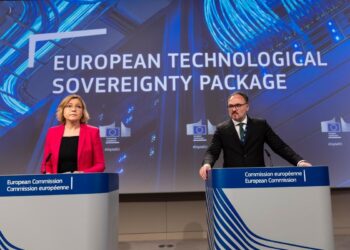
Europe is moving in this direction with the ‘European Technological Sovereignty Package’, a legislative initiative – covering semiconductors, the cloud, open source and AI – which introduces new regulatory obligations, sovereignty standards and an investment plan running until 2036.
Three key themes are addressed: from competitive positioning to new requirements for the public sector and regulated sectors, right through to new and interesting funding opportunities. These three key themes are addressed through four interconnected initiatives, ranging from the CADA (Cloud and AI Development Act) to the EU Open Source Strategy, and from the Chips Act 2.0 to the Strategic Roadmap for Digitalisation and AI in energy.
A clear path has been charted to ensure that European-owned companies are best positioned to compete in the markets. A path towards greater technological independence in AI. And once again, sovereignty takes center stage, as it is the key to everything.
And for those representing industry, this is less and less an ideological issue and increasingly a matter of operational resilience and geopolitical exposure. Digital sovereignty is about risk management; it is about not becoming hostage to technological lock-in. Today, more than ever, it is a matter for the board of directors.
So what can be done to regain sovereignty? We need to promote Italian technology.
Three things follow on from the above: firstly, we need to use demand as a lever, pushing for public procurement and industrial contracts to priorities European added value.
Secondly: use open source as a multiplier, so that an open, European model becomes a platform on which companies can then build their own solutions.
Last but not least: bringing AI into SMEs (if we look at the Italian landscape, but not only that – also at much of the European landscape). The aim is clear: to implement the technology from the ground up, using a bottom-up approach, rather than imposing it from above. A technology that is sustainable, sovereign and deployable where it is needed.
In my view, the European ICT sector must focus on lightweight, efficient models capable of running even on small-scale systems, in the cloud, on-premises and at the edge. Vertical models, trained on the company’s proprietary data.
The question to ask is not how big the model is, but how well it understands my problem.
We can and must start from the requirements and needs of individual districts, understood as domain clusters. We must start from the needs of a sector to build a domain model trained on shared knowledge. A collective asset, preferably open source, funded and governed by the cluster itself.
A word often bandied about, sometimes misunderstood, not always grasped: ‘sustainability’. By being sustainable, AI thrives in the practical reality of its application. This is a different perspective from the mainstream narrative that characterizes it: I focus on the social aspect (as well as, of course, the environmental one) of sustainability. Because AI cannot survive without the industry that uses it and, in other words, there is no AI without a market.
“That’s AI, baby!,” to borrow the words from the film Deadline U.S.A. At the heart of it all are market demands, which dictate the pace of machine evolution and the development of the devices designed to make them work ever more effectively. Research is all well and good, and extremely useful; kudos to valuable initiatives, such as those launched by Nobel laureate Giorgio Parisi, who is proposing a European center for artificial intelligence modelled on CERN.
But research alone is not enough, because the market exists, and it is this that ultimately calls the shots.
Mind you, this does not mean there is no longer any scope for action by non-private entities. Public and private sectors should work together. This contributes to the creation of a collective intelligence within the economic supply chain, without ever succumbing to a vision of short-sighted individualism. Models evolve and circulate: what remains is the data – and this is truly sovereign.
* Valeria Sandei is Chief Global AI at Almaviva Group and CEO of Almawave, a Group company active in the field of Data & Artificial Intelligence. Among her other roles, she serves as Chair of The Data Appeal Company, SisTer, Almawave do Brasil, Almawave Corp, and Mabrian Technologies. She is also a member of the Board of Directors of Tivit, a Brazilian IT company that joined the Group in 2025, and of Almaviva Solutions, a pillar of the Brazilian IT market.
Also in 2025, Sandei received the Italia Informa Award for Italian Excellence, the Key4biz Award for Artificial Intelligence, and the John McCarthy Award. She has been included in Fortune Italia’s list of the 100 most influential women of 2024 and in Forbes’ list of the 100 best managers of 2024.
She is also a member of the B7 Advisory Board, the Unicredit Centro Advisory Board, and the Astrid Observatory on Artificial Intelligence; she is a co-author of three U.S. patents; and she serves on the Scientific Committee of the AI & Business Strategy MBA program at the RCS Academy Business School.
![Il commissario per l'Economia, Valdis Dombrovskis, al Brussels Economic Forum [Bruxelles, 7 maggio 2026]](https://www.eunews.it/wp-content/uploads/2026/05/dombro-bef-350x250.png)


![Il ministro dei Trasporti, Matteo Salvini [Bruxelles, 5 dicembre 2024. Foto: Emanuele Bonini per Eunews]](https://www.eunews.it/wp-content/uploads/2024/12/salvini241205-120x86.jpeg)